
Buying Off-Plan Property in Italy: What Can Go Wrong and How to Protect Yourself
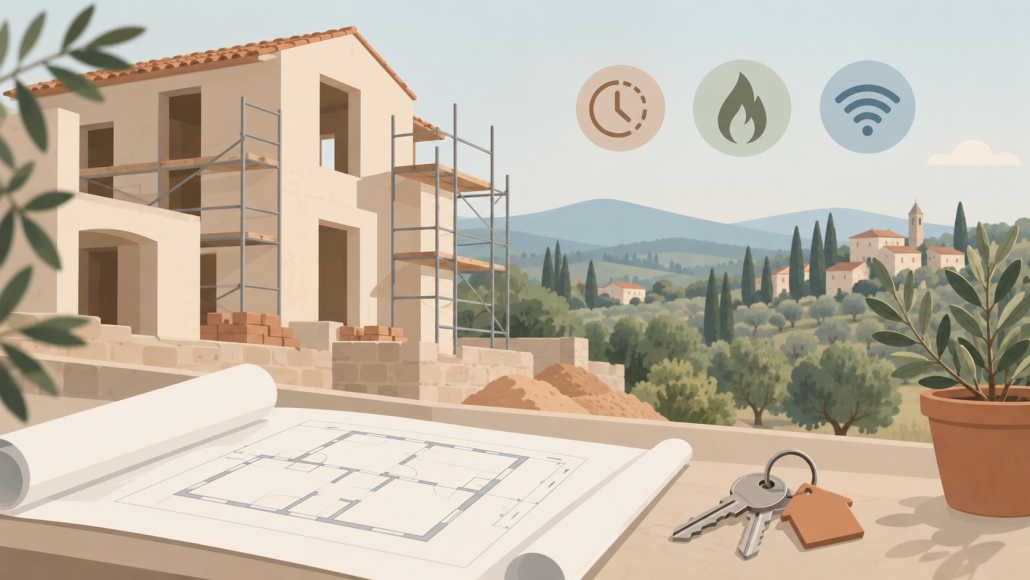
Buying a newly built home in Italy can be extremely attractive.
You choose a new apartment, perhaps select some of the finishes yourself, avoid the renovation problems that often come with older Italian properties and move into a home that has never been lived in before.
Sometimes you may even buy at an attractive price before the development has been completed.
But there is one fundamental difference between buying an existing property and buying off-plan:
you are purchasing something that does not yet fully exist.
You are therefore relying not only on what you can see, but on plans, specifications, measurements, deadlines and promises about what the finished property — and sometimes the entire development around it — will eventually become.
That makes the contract particularly important.
A recent case involving one of my clients is a good example of what can happen when those risks are not properly considered before the purchase.
A Case of an Off-Plan Purchase in Southern Italy
My client purchased a newly built property in Southern Italy directly from the developer while construction was still underway.
She did so without independent legal assistance.
By the time she contacted me, the transaction had already been completed.
At that point, the question was no longer how to structure the purchase safely.
The question had become: how do we deal with everything that has gone wrong afterwards?
The problems concerned almost every stage of the development.
There were substantial delays.
The original project changed during construction.
The apartment she eventually received was not exactly what she believed she had agreed to buy.
There were unfinished works and defects.
And once she began actually using the property, she discovered practical limitations that had never been properly discussed before the purchase.
None of these risks is unique to Italy.
But when buying a property under construction in another country, they become considerably more difficult to manage.
What Does “Buying Off-Plan” Mean in Italy?
An off-plan purchase normally involves agreeing to buy a property before construction has been completed.
Sometimes the building is already partially constructed.
Sometimes the purchaser is effectively buying from architectural plans and specifications while much of the development still needs to be built.
Italian law provides specific protections for certain purchases of immobili da costruire — properties under construction — particularly under Legislative Decree No. 122/2005.
Where the statutory requirements are satisfied, the protections can include specific requirements concerning the preliminary contract, a bank or insurance guarantee protecting certain sums paid before ownership transfers, and a ten-year insurance policy covering specified serious construction defects.
For developments whose relevant building title was requested or submitted from 16 March 2019, the applicable regime also requires qualifying preliminary contracts to be executed by public deed or authenticated private agreement, involving a notary and registration in the property registers.
However, the statutory regime has precise subjective and objective requirements.
You should therefore not assume that every transaction marketed as an “off-plan purchase” automatically falls within exactly the same legal framework or benefits from every statutory protection.
That needs to be checked in the individual transaction.
Risk No. 1: The Property Is Delivered Late
One of the most obvious risks when purchasing a property under construction is delay.
In my client’s case, the anticipated completion date came and went.
The developer accumulated significant delays and the buyer remained in uncertainty for a considerable period.
For somebody moving to Italy from abroad, this can cause much more than frustration.
A delayed property may affect:
- temporary accommodation;
- international moving arrangements;
- storage costs;
- flights and travel;
- residence plans;
- the sale or termination of accommodation abroad;
- and, quite simply, where you are going to live.
What Should the Contract Say About Delays?
An off-plan contract should therefore do more than indicate an approximate date on which everyone hopes the property will be ready.
Before signing, I would want to understand:
What is the actual contractual completion date?
And then:
What happens if that date is missed?
There is a significant difference between a contract stating that the developer expects to finish “approximately” by a particular month and one establishing clear contractual obligations and remedies.
Depending on the transaction, questions may include:
- Is there a grace period?
- What delays are considered excusable?
- Can the developer extend the deadline unilaterally?
- Is there a penalty for substantial delay?
- At what point may the buyer terminate the agreement?
- What happens to money already paid?
These issues are relatively easy to discuss before the contract is signed.
They become considerably more difficult once the developer is already six or twelve months late.
Risk No. 2: The Development Changes While It Is Being Built
The second problem in my client’s case was particularly important.
The original development contemplated a building containing six apartments.
During construction, however, the project was modified and an additional apartment was created.
That was not merely an aesthetic change.
The configuration of the development changed and my client ultimately received less space than she believed she had agreed to purchase.
This illustrates one of the fundamental risks of buying something that does not yet physically exist.
The Plans Are Part of What You Are Buying
When purchasing an existing apartment, you can normally visit it.
You can walk through the rooms.
You can measure them.
You can see the terrace, garden, parking space and common areas.
With an off-plan property, much of this exists only on paper.
The plans, measurements, technical specifications and description of the development are therefore not secondary documents.
They define what you are purchasing.
Italian legislation concerning qualifying properties under construction specifically requires detailed information in the preliminary contract, including the description of the property, the agreed completion deadline, price and payment arrangements, and relevant construction documentation. The specifications and project drawings also play an important role in identifying what is to be delivered.
Pay Particular Attention to the Developer’s Right to Make Changes
Developers may legitimately need some flexibility during construction.
Not every minor variation should require an entirely new negotiation.
But there is a major difference between allowing reasonable technical modifications and giving the developer extremely broad discretion to alter what you are buying.
Before signing, I would therefore examine carefully provisions dealing with:
- changes to the internal layout;
- surface area and measurements;
- terraces, gardens and balconies;
- parking spaces and garages;
- common areas;
- materials and finishes;
- number and configuration of units within the development;
- and the circumstances in which the developer can depart from the original project.
A clause that appears relatively unimportant when you sign can become crucial if the finished development looks materially different from the one you agreed to purchase.
Risk No. 3: You Receive the Keys, but Not a Finished Home
Eventually, my client’s property was delivered.
Unfortunately, receiving the keys did not mean that the problems were over.
There were unfinished works, defects and various items that still required correction or completion.
This is another critical stage in any new-build transaction.
By this point, buyers are often tired.
They may already have waited months longer than expected.
Their furniture may be arriving.
They may have flights booked or accommodation elsewhere coming to an end.
The temptation is therefore understandable:
take the keys, move in and sort everything out later.
But delivery is precisely the moment when caution is required.
Inspect the Property Before Accepting Delivery
Before the final stages of a new-build purchase, the apartment should ideally be inspected carefully with an appropriate technical professional.
This is sometimes described informally as a snagging inspection.
The purpose is to identify and document problems such as:
- incomplete works;
- damaged finishes;
- doors or windows that do not operate correctly;
- defects in flooring or tiling;
- plumbing or electrical issues;
- moisture or water infiltration;
- items that differ from the agreed specifications;
- missing fixtures;
- and works that remain to be completed.
The objective is not merely to prepare a list of cosmetic complaints.
It is to create a clear record of the condition of the property and establish which items remain the developer’s responsibility.
A buyer who identifies twenty outstanding items before the transaction reaches its final stage may have significantly more practical leverage than a buyer trying to obtain repairs months after taking possession.
Risk No. 4: Problems With the Developer
There is another risk that should never be forgotten when buying something that has not yet been completed:
you are financing part of a future transaction before receiving the finished asset.
What happens if the developer encounters serious financial difficulties after you have already paid substantial deposits?
This is one of the principal reasons Italy introduced specific protections for qualifying buyers of properties under construction.
The Fideiussione: Protecting Money Paid Before Completion
Where the statutory regime applies, the developer must provide the purchaser with a bank or insurance fideiussione covering the relevant sums collected before ownership of the property is transferred.
The purpose is to protect the buyer against the risk of losing money paid towards a property that is never ultimately transferred in circumstances covered by the legislation.
This is not a minor administrative document.
If you are paying substantial amounts to a developer before the property becomes yours, you need to understand exactly what protects that money.
Risk No. 5: Serious Construction Defects Appear Later
Not every defect becomes apparent during the initial inspection.
Some problems emerge only months or years after completion.
For qualifying transactions, Italian law also provides for a ten-year indemnity insurance policy — commonly referred to as the polizza decennale postuma — covering certain material and direct damage associated with total or partial collapse or serious construction defects falling within the relevant statutory regime.
The developer must provide the required policy at the stage specified by the applicable legislation.
Again, the important lesson for a foreign buyer is not simply to assume that because the building is “new”, there can be no significant construction risk.
New construction eliminates some problems associated with historic Italian properties.
It introduces others.
Risk No. 6: The Property Works on Paper — but Not for Your Life
Some of the most frustrating problems in my client’s case were not construction defects at all.
They concerned the surrounding infrastructure.
After purchasing, she discovered that the property was not connected to a mains gas network.
Alternative arrangements using gas cylinders were therefore necessary.
She also discovered that fibre-optic internet was unavailable in the area.
For somebody working remotely, that is not a minor inconvenience.
It can directly affect whether the property is suitable for the life they intended to live there.
Legal Due Diligence Is Not the Same as Practical Due Diligence
Neither the absence of mains gas nor slow internet necessarily makes a property legally defective.
But that is precisely the point.
Good property due diligence should not stop with:
“Does the seller own the land?”
or:
“Are the cadastral records correct?”
Those questions matter enormously.
But there is another question worth asking:
Can this property actually be used in the way you expect to use it?
If you intend to work remotely, verify the internet connection available at the exact address.
If you expect mains gas, check whether the development is actually connected.
If water supply, sewage, parking or road access matter to you, understand how they work before you commit.
If you are buying within a development that remains under construction, determine which parts are fixed and which may still change.
A property can be legally transferable and still be completely unsuitable for your intended lifestyle.
What Should You Check Before Buying Off-Plan in Italy?
There is no single checklist suitable for every development.
But if I were advising a foreign purchaser before signing an agreement for an off-plan property, I would normally want the transaction examined from at least three different perspectives.
1. The Developer and the Legal Structure of the Transaction
You need to understand who you are contracting with and what exactly they have the legal right to build and sell.
Depending on the case, this may involve examining:
- ownership of the land;
- the developer’s corporate identity;
- mortgages, liens and other registered burdens;
- the relevant building permits or other planning titles;
- financing affecting the development;
- the structure of payments;
- whether the statutory protections for properties under construction apply;
- and the guarantees securing sums paid before the final transfer.
2. The Preliminary Contract
The preliminary agreement is particularly important because this is where many of the buyer’s rights and obligations become fixed.
Among other things, I would want to examine:
- the exact property being purchased;
- floor area and measurements;
- plans and drawings;
- private external areas;
- parking and storage;
- common areas;
- construction specifications;
- materials and finishes;
- purchase price;
- payment stages;
- completion deadline;
- consequences of delay;
- permitted modifications;
- circumstances allowing the buyer to withdraw;
- and what must happen before the final purchase is completed.
For qualifying purchases under the post-2019 regime, Italian law itself requires the preliminary contract to contain specific information and documentation and to be executed through the prescribed notarial form.
3. The Technical Side of the Development
A lawyer should not replace the architect, engineer or geometra.
The roles are complementary.
For an off-plan transaction, I would generally want an independent technical professional to consider matters such as:
- approved construction plans;
- planning compliance;
- correspondence between what has been approved and what is being built;
- construction progress;
- technical specifications;
- variations;
- measurements;
- completion of works;
- and defects identified before delivery.
The legal documentation tells us what the developer has promised.
The technical inspection helps determine whether that promise has actually been delivered.
What Should You Ask Before Signing?
Before committing to an off-plan purchase in Italy, I would want clear answers to questions such as:
About the property
What exactly am I buying?
What is the agreed internal and external surface area?
Which plans are contractually binding?
What are my exclusive areas and what are common areas?
What materials and finishes are promised?
About changes
What can the developer modify without my consent?
Can the apartment dimensions change?
Can the configuration of the overall development change?
What happens if the final property is materially different from the agreed plans?
About time
When must construction be completed?
When must the property be delivered?
What happens if there is a delay?
At what point does a delay become serious enough to trigger a contractual remedy?
About money
How much do I pay before completion?
When are the instalments due?
What guarantees protect those payments?
What happens to my money if the project does not proceed as expected?
About delivery
What condition must the apartment be in before I am required to accept it?
Who checks outstanding defects?
Can sums be retained pending completion of identified works, if appropriately agreed?
How will unfinished items be documented?
About the development itself
What utilities will actually be connected?
Is mains gas available?
What water and sewage arrangements exist?
What internet connection is available at the address?
What parking rights are included?
What common facilities still have to be completed?
These questions may seem excessive when you are standing in a sales office looking at beautiful architectural renderings.
They seem considerably less excessive when something goes wrong.
The Lawyer, Notary and Technical Professional Have Different Roles
One point is particularly important for foreign purchasers.
The fact that a notary will eventually be involved does not mean that there is no role for independent legal assistance.
For qualifying purchases of properties under construction, the notary has a particularly significant statutory role, including at the preliminary-contract stage under the current regime. The notary’s involvement provides important protections concerning formal validity, registration and statutory guarantees.
But your lawyer approaches the transaction from a different perspective.
The lawyer represents your interests.
The questions are therefore not limited to whether the transaction can legally proceed.
They include:
Is this contract good enough for my client?
What happens to my client if the developer is late?
Can the developer alter this project?
What exactly has been promised?
What remedies will my client actually have if the finished property is different?
Is there a risk we should negotiate before signing rather than litigate about afterwards?
And alongside the lawyer and notary, an independent technical professional can assess the matters that require architectural, building or engineering expertise.
For an off-plan purchase, those three perspectives can be extremely valuable.
Can All Problems Be Prevented?
No.
No lawyer can guarantee that a developer will never be late.
No architect can guarantee that construction will be absolutely perfect.
No contract can ensure that a dispute will never arise.
Due diligence does not eliminate every risk.
It changes who bears the risk and what happens when the risk materialises.
If a developer is six months late, there is an enormous difference between asking afterwards:
“What can we do?”
and opening the contract and finding a provision specifically negotiated for that situation.
If the size of an apartment changes, there is a difference between arguing about what a brochure appeared to promise and having precise plans and measurements incorporated into the contractual documentation.
If defects remain at delivery, there is a difference between complaining months later and having them formally documented before the final stages of the transaction.
That is what good legal planning is supposed to accomplish.
Buying Off-Plan in Italy: The Earlier You Investigate, the Better
Buying an off-plan property in Italy is not necessarily a bad idea.
There are excellent developers and excellent projects throughout the country.
But it is a transaction in which a large part of what you are paying for still exists only in:
plans, specifications, contracts and promises.
Those documents therefore deserve at least as much attention as the finished apartment eventually will.
My client came to me after completing her purchase because she now needs assistance dealing with the consequences of what happened during construction and delivery.
Sometimes problems only become apparent later and that cannot be avoided.
But whenever possible, the better moment to involve your legal and technical advisers is before you sign, before substantial amounts are paid and before the developer’s problems become your problems.
If you need legal assistance, feel free to get in touch.
Antonio Strangio
BDB Relocation and Legal

