
Making an Offer on a Property in Italy: What You Need to Know Before You Sign
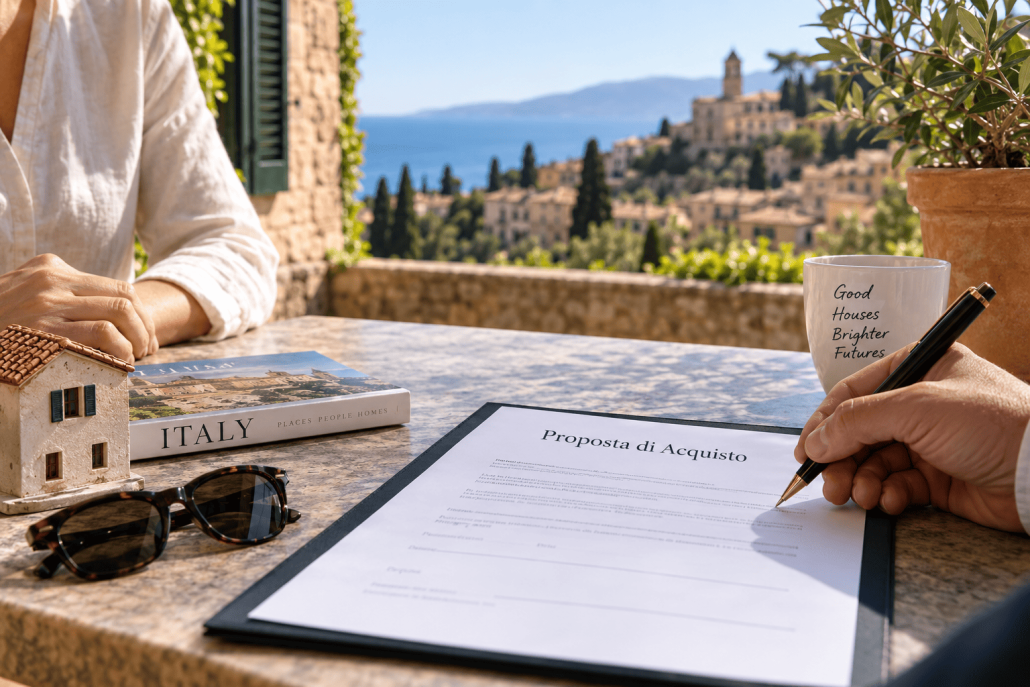
You found the house.
The terrace is perfect. The view is even better. The price seems reasonable.
You have visited the property, perhaps spoken to the seller, and everything seems to be moving in the right direction.
Then the estate agent puts a document in front of you and says:
“We just need an offer to secure the property.”
This is usually the moment when buyers relax.
They shouldn’t.
In Italy, a proposta di acquisto — a formal purchase offer — should not be treated as a simple expression of interest.
Once signed, it can already create obligations for the buyer. And once accepted by the seller, if the document contains the necessary elements of the transaction, it can effectively become the binding preliminary agreement between the parties.
That means one of the most important moments in an Italian property purchase can occur before the notary, before the rogito and sometimes before the legal and technical due diligence has even been completed.
For a foreign buyer, that is something worth understanding before signing anything.
What Is a Proposta di Acquisto?
A proposta di acquisto is the written offer through which a prospective buyer proposes to purchase a particular property on specified terms.
In practice, it is frequently prepared using a standard form supplied by the estate agency.
It normally identifies:
- the buyer and seller;
- the property;
- the proposed purchase price;
- the initial deposit;
- the deadline for acceptance;
- the expected completion date;
- and any conditions attached to the purchase.
At first sight, this can look like an administrative step designed simply to show the seller that you are serious.
Legally, however, it may be considerably more important.
Is a Property Offer in Italy Binding?
Potentially, yes.
Once the purchaser signs an offer, the purchaser may already be bound by its terms for the period specified in the document.
If the seller accepts the proposal within that period and the document contains the essential terms necessary to constitute an agreement, the accepted proposal may operate as a contratto preliminare — the preliminary purchase agreement.
The Italian Notariat specifically warns buyers about this distinction: the proposal is not simply an informal expression of interest, and once accepted it can become the preliminary agreement between buyer and seller.
That is why the sentence:
“Don’t worry, it’s only an offer.”
should make you cautious.
It may only be an offer until the seller accepts it.
After that, withdrawing may have very different consequences.
Why This Matters for Foreign Buyers
Many foreign purchasers expect the transaction to work differently.
They assume that the serious legal commitment will happen later, perhaps when they sign a formal preliminary contract or when they attend the final deed before the notary.
But by then, some of the most important contractual decisions may already have been made.
If your accepted offer says:
- you will buy the property for €350,000;
- completion will occur by a specified date;
- €20,000 constitutes a deposit;
- there are no conditions relating to technical compliance;
- and there is no financing condition;
you cannot necessarily introduce new protections later simply because you subsequently decide they would have been useful.
This is why I normally prefer to understand the risks of the property before the buyer becomes unconditionally committed.
What Should a Property Offer in Italy Contain?
There is no universal offer suitable for every property.
A renovated apartment in central Florence, a rural farmhouse in Umbria and a villa undergoing planning regularisation in Sicily present completely different risks.
The offer should reflect those risks.
There are, however, several areas that should always be considered carefully.
1. A Precise Description of What You Are Buying
This sounds obvious.
It often is not.
The offer should identify precisely what is included in the transaction.
That may mean not only the apartment or house itself, but also:
- garage;
- cellar;
- parking space;
- garden;
- terrace;
- storage room;
- agricultural or surrounding land;
- annexes;
- and other portions being transferred together with the main property.
What About Furniture?
This is particularly relevant in purchases involving foreign buyers.
You may visit a furnished Italian home and be told:
“Everything stays.”
That may be perfectly genuine.
But if the furniture, appliances, lighting fixtures or other items matter to the transaction, I would not rely exclusively on an oral understanding.
They should be identified in writing.
If the antique dining table is part of the deal, say so.
If the kitchen appliances remain, say so.
If the seller is removing everything except certain specifically identified items, make that clear.
The safest rule is simple:
If it matters to you, put it in the contract.
2. The Purchase Price — and Exactly How It Will Be Paid
The total purchase price is only the beginning.
Suppose you offer €300,000.
The agreement should also make clear:
- how much is paid when the offer is made;
- where that money is held before acceptance;
- what happens to it if the seller does not accept;
- what happens to it once the offer is accepted;
- whether further payments are due before completion;
- and how much remains payable at the final deed.
Caparra Confirmatoria or Acconto?
One particularly important question concerns the legal nature of the initial payment.
Is it a caparra confirmatoria?
Or is it simply an acconto sul prezzo — an advance payment towards the purchase price?
These are not necessarily the same thing.
The distinction can become extremely important if one party subsequently fails to complete the transaction.
Italian tax authorities themselves distinguish between the two categories, and the Notariat stresses the importance of stating clearly whether money paid before the final deed constitutes a deposit or an advance towards the price.
This should therefore never be treated as meaningless terminology in a standard form.
3. The Conditions That Allow You Not to Proceed
This is often the most important part of the offer.
Imagine signing an unconditional proposal and discovering two weeks later that:
the extension overlooking the garden was built without the necessary authorisation;
the actual property does not correspond with its approved building plans;
there is a mortgage or other issue affecting title;
the seller does not have the documentation you expected;
significant extraordinary condominium works have already been approved;
or the bank refuses your mortgage.
At that point, saying:
“Had I known this, I would never have made the offer.”
does not necessarily solve the problem.
Use Conditions Before You Become Bound
Depending on the property and the buyer’s circumstances, the offer may need to be conditional upon matters such as:
- satisfactory legal due diligence;
- satisfactory technical due diligence;
- planning and building compliance;
- cadastral conformity;
- verification of title;
- cancellation of mortgages or other encumbrances;
- mortgage financing;
- review of condominium documentation;
- absence of undisclosed condominium debts;
- verification of extraordinary works;
- production of missing documentation;
- or regularisation of identified issues.
The important point is that the protections should reflect the actual risks of the transaction.
A countryside property requiring significant technical investigation should not necessarily be purchased using exactly the same standard conditions as a recently constructed apartment.
“Subject to Due Diligence” May Not Be Enough
Foreign buyers sometimes understand that they need protection and insert a generic sentence such as:
“Offer subject to satisfactory due diligence.”
That is better than nothing.
But it may still leave considerable room for disagreement.
What does “due diligence” actually include?
Who decides whether the result is satisfactory?
Which documents must be provided?
How long does the buyer have to complete the checks?
What happens if a problem is discovered?
Can the buyer withdraw?
Does the deposit have to be returned?
A properly drafted condition should make the mechanism as clear as possible.
The objective is not merely to include comforting words in the contract.
The objective is to know exactly what happens if the check identifies a problem.
4. Make Sure the Timetable Is Realistic
Property transactions take time.
This is particularly true when the buyer lives abroad.
Your lawyer may need to review documentation.
A geometra, architect or engineer may need to access municipal records and inspect the property.
The notary needs time to conduct the checks necessary for completion.
You may need an Italian tax code, a bank account, a power of attorney or international transfers.
The seller may also need time to resolve existing issues.
Your offer should take this into account.
How Long Is the Offer Open?
The proposal should specify the period during which the seller can accept it.
During that period, depending on the form of the proposal, the buyer may already be committed to keeping the offer open.
Avoid agreeing casually to unnecessarily long periods.
When Will the Rogito Take Place?
The expected date for the final deed should also be realistic.
An artificially short deadline may create pressure precisely when you need time to investigate the property properly.
On the other hand, a very long and vague completion period can leave the buyer tied to a transaction for months without sufficient certainty.
The timetable should work with the due-diligence process, not against it.
5. Think About What Must Happen Before the Rogito
When buyers sign the offer, they naturally focus on getting the seller to say yes.
I prefer to look further ahead.
Ask yourself:
What condition do I expect this property to be in when I finally receive the keys?
That question often identifies contractual issues that would otherwise be overlooked.
Will the Property Be Vacant?
If you expect vacant possession, make that clear.
This can be particularly important if the property is occupied by:
- the seller;
- family members;
- tenants;
- guests;
- or other persons.
You do not want to discover shortly before completion that possession will be delivered later than expected.
What Happens to the Furniture?
If the seller is supposed to remove furniture, personal belongings or rubbish before completion, this should be addressed.
Likewise, if particular furniture is included in the purchase, identify it.
What About Condominium Charges?
For an apartment in a condominium, understand the position regarding:
- ordinary condominium charges;
- arrears;
- extraordinary expenditure;
- works already approved;
- ongoing litigation;
- and decisions already taken by the condominium assembly.
A property can look perfectly attractive during a viewing while carrying the economic consequences of a substantial roof, façade or structural project already approved by the condominium.
That is something I would want to discover before the buyer becomes unconditionally bound.
6. Existing Mortgages and Other Encumbrances
The existence of a mortgage over a property does not necessarily prevent the purchase.
Italian properties are frequently sold while an existing seller’s mortgage is still registered.
What matters is understanding how and when it will be cancelled.
The agreement should be structured so that the purchaser receives the property in the legal condition that has been promised.
Similar attention may be required for other registered rights or burdens affecting the property.
Again, do not wait until the final days before the rogito to ask these questions.
7. What If the Seller Needs to Fix Something Before Completion?
Due diligence often identifies an issue that is capable of being resolved.
Perhaps the property needs a planning regularisation.
Perhaps a cadastral update is required.
Perhaps a document needs to be obtained.
Perhaps an existing mortgage must be cancelled.
That does not necessarily mean the transaction should be abandoned.
But if the seller is expected to fix something, the obligation needs to be clear.
Ask:
What exactly must the seller do?
By what date?
At whose cost?
What happens if it is not completed?
A promise such as:
“Don’t worry, we’ll sort that out before closing.”
may be reassuring during a friendly negotiation.
A properly drafted contractual obligation is considerably more useful if something goes wrong.
8. Do Not Confuse the Estate Agent With Your Own Adviser
The estate agent has an important role in bringing the transaction together.
But the agency’s standard proposal is not necessarily designed around your particular legal risks.
It may be an entirely reasonable standard document.
The problem is that your property may not involve a standard situation.
Perhaps you are:
- buying without seeing the property personally;
- financing the purchase;
- purchasing an old farmhouse;
- buying through a power of attorney;
- purchasing a property affected by building irregularities;
- buying something with substantial land;
- depending on the property for Italian residency;
- or purchasing in a condominium where major works are planned.
A standard form cannot anticipate every one of those circumstances.
The question is therefore not:
“Is this a normal proposal?”
The better question is:
“Does this proposal protect me in this particular transaction?”
The Offer Should Come After the First Checks — Not Before Them
There is often commercial pressure to move quickly.
You may be told that another buyer is interested.
The seller may want an answer by tomorrow.
The agent may say that an offer is needed immediately to “take the property off the market”.
Sometimes that urgency is real.
But urgency does not change the legal consequences of what you sign.
Whenever possible, I prefer the buyer to understand at least the basic legal and technical position before making an unconditional offer.
If full due diligence cannot realistically be completed beforehand, then the offer should be drafted so that the necessary checks can still take place without leaving the buyer trapped if a serious problem emerges.
That is a much safer way to move quickly.
A Practical Checklist Before Making an Offer on Property in Italy
Before signing a proposta di acquisto, I would want a foreign buyer to be able to answer at least these questions:
The property
Do I know exactly what I am buying?
Are the garage, cellar, garden, land and parking included?
Is furniture included or excluded?
The money
What is the exact purchase price?
How much am I paying now?
Is that payment a caparra confirmatoria or an acconto?
When are further payments due?
The checks
Have the legal documents been reviewed?
Has the building and planning position been checked?
Have the cadastral documents been reviewed?
Do I need a technical inspection?
What happens if those checks identify a serious problem?
The financing
Do I need a mortgage?
If so, is the purchase properly conditional upon financing?
The condominium
Are there unpaid condominium expenses?
Have extraordinary works already been approved?
Is there ongoing litigation?
The seller
Does the seller have anything to correct or regularise before completion?
Is there an existing mortgage?
Will the property be vacant at completion?
The timing
How long can the seller accept my offer?
When will the final deed take place?
Is there enough time to complete the necessary checks?
The exit
Most importantly:
Under what circumstances can I legally walk away and recover the money I have paid?
If you cannot answer that question after reading the proposal, I would be very reluctant to sign it.
The Most Important Contract May Be the First One You Sign
Foreign buyers often focus heavily on the final deed.
They imagine that the rogito before the Italian notary is the moment when the transaction really becomes serious.
Legally, the ownership of the property does indeed transfer at the final deed.
But from a negotiation and risk-management perspective, the decisive moment may come much earlier.
It may come when you sign the piece of paper the estate agent calls:
“the offer.”
By the time you arrive at the notary’s office, you may already have agreed on the property, the price, the deposit, the deadline and many of the conditions governing the transaction.
That is why I would treat the proposta di acquisto as one of the most important documents in the entire Italian property purchase process.
Do the checks first where possible.
Identify the risks.
Add the protections you need.
And then make the offer.
Because it is much easier to negotiate protection before you sign than to discover afterwards that you signed it away.
If you need legal assistance, feel free to get in touch.
Antonio Strangio
BDB Relocation and Legal

